
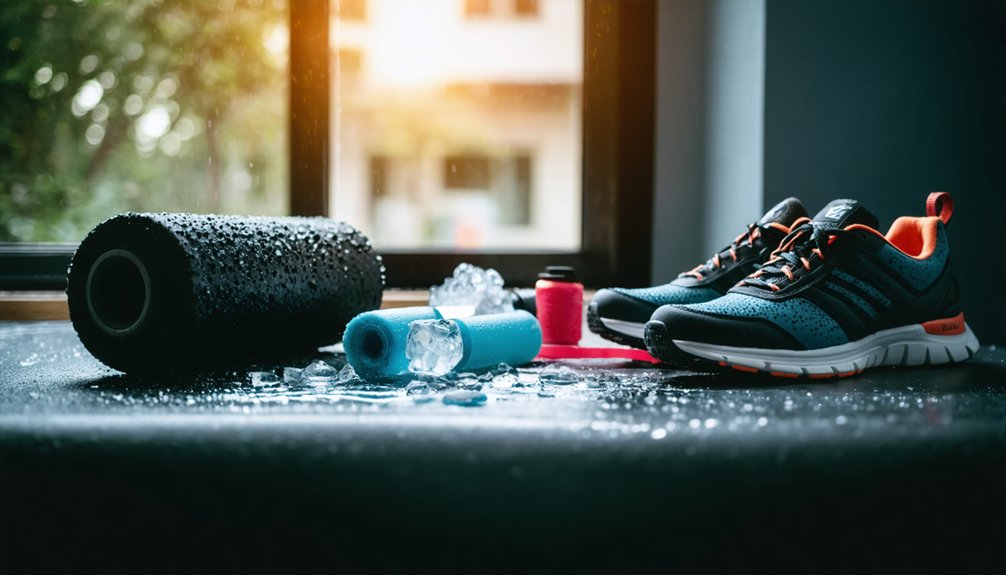

You can accelerate recovery and maintain performance by using targeted tools that speed circulation, reduce inflammation, and support cellular repair. Foam rolling and percussion boost blood flow, break adhesions, and cut soreness so you preserve power. Compression and pneumatic devices improve venous return to clear metabolites. Cryotherapy and photobiomodulation modulate inflammatory signaling and mitochondrial function. Blood flow restriction amplifies anabolic signaling with low loads. Use these strategically after sessions, and you’ll find practical protocols and timing that maximize gains.
Key Takeaways
- Recovery tools accelerate metabolic waste clearance and blood flow, speeding replenishment of oxygen and glycogen for improved subsequent performance.
- Foam rolling and percussion reduce DOMS and increase range of motion without impairing strength or power output.
- Graduated compression and pneumatic devices enhance venous return, lowering lactate and creatine kinase to shorten recovery windows.
- Timed nutrition (protein+carbs within 30 minutes) and sleep (7–9 hours) synergize with modalities to maximize muscle repair and function.
- Contrast, cold immediately and heat 24–72 hours later, modulate inflammation and tissue remodeling to support long-term performance gains.
The Science Behind Muscle Repair and Recovery
Although muscle repair follows a predictable sequence, its success depends on tightly coordinated cellular, inflammatory, and nutritional processes that you can influence, monitor, and optimize. You should recognize five interrelated phases—degeneration, inflammation, regeneration, maturation/remodeling, and functional recovery—each driven by precise extracellular signaling among immune, myogenic, vascular, and fibrotic cells. Early necrosis and hematoma recruit Ly6C^high^ monocytes that become M1 macrophages to clear debris; later Ly6C^low^ monocytes shift to M2 phenotypes supporting repair. Satellite activation fuels new myofiber formation while FAPs regulate fibrogenesis and satellite function. Nutrition matters: timely protein and carbohydrate intake enhances glycogen resynthesis and protein synthesis, and electrolytes support cellular repair. You belong to a community of practitioners who use this evidence-based framework to guide recovery choices. Recent research also highlights the role of the complement system as an early innate sensor that promotes inflammatory cell recruitment after injury complement activation. Exercise intensity and duration critically determine the extent of damage and the subsequent regenerative demand exercise dose. Controlled early mobilization also stimulates vascular ingrowth and improves functional outcomes vascularisation.
Foam Rolling: Mechanisms and Practical Benefits
When you apply targeted pressure with a foam roller, you prompt a cascade of mechanical and neurovascular responses that speed recovery and restore function. You increase muscular blood flow, hastening oxygen and nutrient delivery while reducing edema and accelerating lactate clearance. Mechanical pressure breaks fascial adhesions, improving pliability and joint range of motion—often within minutes—without impairing neuromuscular performance. Regular 20-minute sessions or minimum 120 seconds per muscle group cut DOMS by 30–40% at 72 hours and sustain sprint and power outputs. Foam rolling modulates nerve excitability and raises pressure-pain thresholds, aiding tolerance during rehab. Use myofascial mapping to target tissues and integrate clear self treatment protocols into warm-ups and recovery routines so you and your training group progress together with confidence. The fascia, a continuous connective-tissue network that maintains structural integrity, is often implicated in movement restrictions and discomfort, making it a key target for foam-rolling interventions connective tissue. Recent controlled studies using a 20-minute postexercise regimen demonstrated measurable performance preservation in sprint and jump tests, supporting foam-rolling efficacy. Another meta-analysis found small but consistent improvements in flexibility and sprint performance following pre- and post-exercise foam rolling, indicating potential practical benefits for athletes small improvements.
Compression Garments and Pneumatic Systems: Enhancing Circulation
Foam rolling helps restore tissue pliability and local circulation, but you can also harness external compression to move blood and metabolic waste more efficiently across the whole limb.
You’ll find graduated compression garments and pneumatic systems create an external pressure gradient—highest at the extremities, easing toward the core—to speed venous return and reduce peripheral pooling. That enhanced circulation improves oxygen delivery during work and recovery, and research shows measurable gains in circulation metrics and running economy.
Faster venous flow promotes metabolic clearance, lowering lactate and creatine kinase more quickly, shortening recovery windows and reducing soreness. Use moderate, well-fitted compression (not excessive pressure) or targeted pneumatic cycles to optimize vascular tone, thermoregulation, and consistent recovery for your training community. The selection should be based on specific muscle groups and activity demands. Evidence quality is mixed, however, so apply these tools as a supplementary strategy within a broader recovery plan and monitor outcomes for your athletes limited evidence.
Incorporating compression garments into post-workout routines can further support recovery by maintaining improved blood flow.
Percussion Massage Therapy: Faster Range of Motion and Pain Relief
If you want faster range of motion and reliable pain relief, percussion massage delivers targeted, high-frequency pulses that penetrate skin, fascia and muscle to break up adhesions and loosen tight tissue. You’ll feel percussion benefits quickly: rapid bursts dislodge knots, redistribute thickened fascia fluid, and improve fascia mobility so joints move with less resistance. Applied 2–5 minutes before or after activity, vibration therapy enhances flexibility in key muscles and readies you for performance. Pain drops as pulses stimulate nerve endings, engage the gate control mechanism, and trigger endorphin release, easing both acute discomfort and DOMS. Clinically informed protocols—start 30 seconds, avoid bony areas—boost circulation, lactic acid clearance, and lymphatic drainage, helping you recover faster and train consistently. Studies and clinical use show percussion therapy also increases blood flow to muscles, supporting repair and reducing fatigue.
Photobiomodulation and Cryotherapy: Reducing Inflammation and Fatigue
Because targeted light and cold act on different recovery pathways, combining photobiomodulation and cryotherapy gives you a precise toolkit for cutting inflammation and fatigue.
You get mitochondrial stimulation from near-infrared PBM (around 830nm), boosting ATP, improving oxidative capacity, and preserving membrane excitation so muscles sustain more contractions.
Cryotherapy complements PBM by bluntly lowering tissue temperature, reducing metabolic demand and edema.
Together they produce cytokine modulation—PBM lowers TNF-α and CRP while guiding repair, and cold suppresses acute inflammatory signaling—so you recover faster with less DOMS and lower CK at 72 hours.
Applied correctly (dose, wavelength, timing, and localized targeting), this paired approach enhances endurance, reduces lactic buildup, and helps you return to training with confidence and shared purpose.
Blood Flow Restriction and Its Role in Recovery Physiology
When you deliberately restrict venous outflow while preserving arterial inflow, blood flow restriction (BFR) creates a potent recovery stimulus by inducing localized hypoxia and metabolic stress that kickstarts anabolic signaling and accelerates repair.
You’ll harness ischemic preconditioning–like effects as HIF-1α-driven anaerobic metabolism and rapid lactate buildup amplify mTOR signaling, reduce myostatin expression, and boost satellite cell activity.
At low loads (20–30% 1RM) BFR increases fiber type recruitment, engaging type II fibers and matching motor unit activation seen in heavy lifting, so you get structural recovery with less mechanical strain.
Systemic benefits include contralateral strength gains, improved bone markers, and stable arterial compliance.
Use pressures that occlude venous return while preserving arterial inflow (≈40–80% LOP) for safe, evidence-based application.
Comparing Recovery Tools: When to Use Each Modality
Blood flow restriction showed how manipulating circulation can speed repair, but choosing the right recovery tool depends on the injury, timing, and training demands.
You’ll pick foam rolling for mobility and maintenance sessions—90–120 seconds per muscle group post-exercise or on rest days to preserve tissue function—using a durable roller like the TriggerPoint GRID and following equipment maintenance to prevent breakdown.
Use percussive therapy (15–30 seconds per muscle group) within 30 minutes post-workout for targeted sore spots, starting low during acute soreness.
Apply compression (20–30 minutes) for lower-body dominant sports needing 24–48 hour recovery.
Cold plunges within 15 minutes reduce inflammation; heat helps 24–72 hours later.
Match modality to your injury, session timing, and training load for consistent gains.
Designing a Complementary Recovery Routine for Peak Performance
Balancing recovery tools into a coherent routine lets you train harder, recover smarter, and hit peak performance more consistently.
You’ll structure training with periodization—alternate heavy and light weeks, rotate muscle groups, and schedule de-load weeks—to prevent burnout and optimize gains.
Pair active recovery (walking, cycling, yoga) after intense sessions to speed waste clearance and reduce injuries.
Prioritize sleep hygiene: consistent schedules, darkness, and 7–9 hours boost muscle protein synthesis and hormone balance.
Use targeted nutrition timing: consume protein and carbs within 30 minutes post-workout to jumpstart repair and replenish glycogen.
Integrate contrast therapy, stretching, and electrolyte restoration for inflammation control and cramp prevention.
Adopt this evidence-based, community-minded plan so you recover reliably and perform with confidence.
References
- https://www.sportsmith.co/articles/10-recovery-tools-and-techniques/
- https://pmc.ncbi.nlm.nih.gov/articles/PMC6465761/
- https://www.nature.com/articles/s41598-022-21029-2
- https://www.frontiersin.org/journals/public-health/articles/10.3389/fpubh.2025.1561970/full
- https://barbourortho.com/2025/11/best-recovery-tools-for-athletes-what-orthopedic-surgeons-actually-recommend/
- https://pmc.ncbi.nlm.nih.gov/articles/PMC11098991/
- https://www.uchealth.org/today/rest-and-recovery-for-athletes-physiological-psychological-well-being/
- https://performancepartner.gatorade.com/content/resources/pdfs/gssi-sports-recovery-toolkit-full.pdf
- https://pmc.ncbi.nlm.nih.gov/articles/PMC7290814/
- https://www.frontiersin.org/research-topics/65439/exploring-regenerative-pathways-in-muscle-repair