
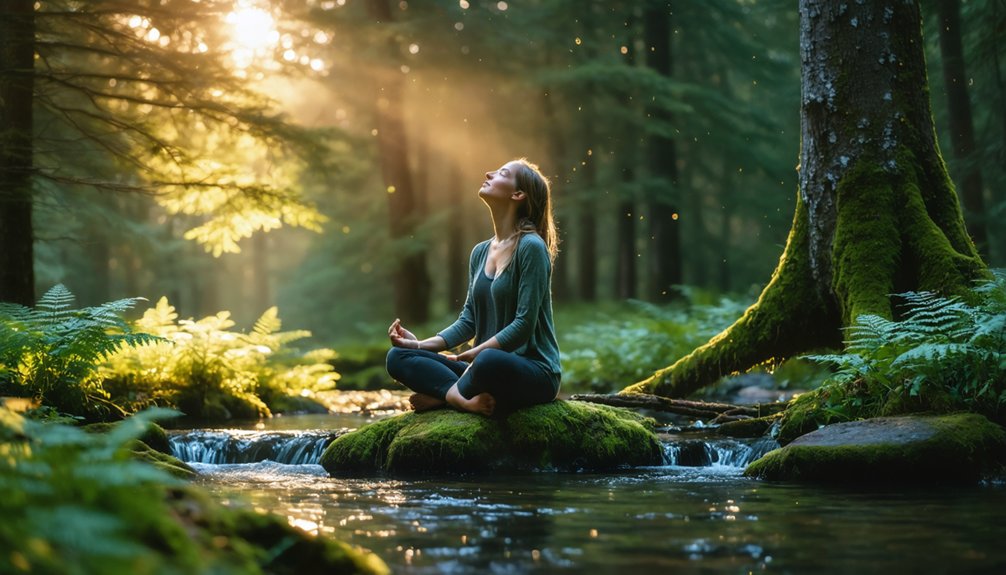

Nature therapy helps you calm physiology and sharpen emotion control within minutes to hours: heart rate, blood pressure and cortisol fall while vagal tone and HRV improve, which reduces reactivity and rumination. Natural settings restore attention and strengthen reappraisal skills, lowering anxiety and depression with as little as 10–50 minute sessions and about 120 minutes weekly for durable gains. Quality, connection, and brief mindful rituals amplify benefits—keep going to explore practical steps and evidence-based techniques.
Key Takeaways
- Natural settings quickly lower physiological stress (heart rate, blood pressure, cortisol) and increase parasympathetic activity, promoting calm.
- Greenspace exposure restores attention and executive control, improving emotional regulation and cognitive reappraisal.
- Short, regular nature visits (10–50 minutes; ~120 minutes weekly) reliably reduce anxiety and depressive symptoms.
- Mindful immersion and nature-connectedness reduce rumination and strengthen self-identity, amplifying mood benefits.
- High-quality, accessible nature (biodiversity, water, safety) and guided therapeutic modalities enhance restorative and clinical outcomes.
The Physiology of Stress Reduction in Natural Settings
When you step into a natural setting, your body begins a rapid, measurable shift from a stress state toward relaxation: parasympathetic activity rises while sympathetic arousal falls, heart rate and blood pressure drop, and HRV patterns change (notably a reduced LF/HF ratio) within minutes.
You’ll notice vagal tone increases as nature exposure activates the parasympathetic brake, lowering cortisol and calming autonomic reactivity. Studies show HRV biofeedback-like effects emerge without training: HRV improves, LF/HF declines, and cardiovascular markers normalize within 10–50 minutes.
Immune and neurophysiological markers follow—NK cell activity rises, muscle tension and EEG stress signatures fall. Systematic reviews confirm this isn’t anecdote; systematic reviews and controlled trials confirm nature produces reliable, rapid physiological shifts that support group and individual well-being.
Research from forest medicine groups further documents phytoncide effects on immune function. Spending even short weekly periods in green spaces produces measurable mental-health benefits, including reduced rumination and improved attention ~120 minutes/week.
How Nature Improves Emotional Regulation Skills
Although often subtle, exposure to natural settings reliably strengthens the skills you use to manage emotions: it boosts cognitive reappraisal—helping you reinterpret challenging situations—and reduces reliance on expressive suppression, with these shifts partly explained by increased nature connectedness.
You’ll find that attention restoration in greenspaces restores executive control, making it easier to reframe stressors and choose adaptive responses.
The environmental self regulation hypothesis shows your surroundings act as a tool: nature prompts situation selection and modification, supports mindfulness, and lowers negative affect while increasing positive emotion.
Evidence shows direct nature contact predicts greater reappraisal and less suppression even after controlling for demographics. Recent research with urban Chinese young adults found these effects in a sample of over 2,000 participants, highlighting the relevance for young adults in cities. This is consistent with studies of mindfulness-based programs delivered in natural settings that report improvements in self-regulation through residential mindfulness retreats.
In therapy and community programs, these mechanisms create inclusive settings where you learn durable emotional regulation skills alongside others who value connection. New systematic reviews from the last decade consistently link nature exposure to reduced stress and improved wellbeing, supporting the broader theoretical framework that nature benefits emotional health via restorative processes and innate preferences for natural environments decreased stress.
Minimum Time and Frequency Needed for Mental Health Benefits
Because even brief encounters with nature produce measurable benefits, you don’t need hours in the wilderness to improve mood, reduce stress hormones, and sharpen attention—10 to 20 minutes per session already yields reliable psychological and physiological gains, and a weekly target of about 120 minutes (spread across 2–3 visits) aligns with large-sample evidence for lower depression and better well-being.
You can use micro breaks—short, intentional pauses outdoors or even virtual nature—to accumulate benefit daily. Research supports 10–50 minute sessions, with three 20–30 minute outings weekly ideal for lowering cortisol and restoring attention.
Aim for consistent nature dosing: short, regular exposure beats one long weekend visit. Choose nearby green spaces you share with others, so these routines feel achievable and welcoming. A growing body of research also supports the idea that people have an inherent affinity for natural environments, known as the biophilia hypothesis. Evidence from college-student studies shows that just 10 minutes of sitting or walking in nature can produce significant mental-health benefits. Recent large reviews also link reduced anxiety with regular green-space exposure.
Deepening Nature Connectedness to Boost Well-Being
As you cultivate a stronger bond with the natural world, measurable improvements in mood, reduced medication use, and lower psychological distress often follow, independent of how much green space you live near or how often you visit it.
You can deepen connectedness through mindful immersion—slowing sensory intake, tracking attention restoration, and reducing rumination—to access neural benefits like lowered subgenual prefrontal activity.
Use identity rituals that reinforce belonging: regular nature naming, reflective journaling, and small conservation acts that shift self-identification toward nature.
Research shows enjoyment-related aspects reliably lower depression and anxiety, while stronger connection amplifies gains from visits.
If you feel distant, start with brief, consistent practices that build cognitive integration; benefits accrue across seasons, ages, and cultures, and often reduce reliance on medication. Adding intentionality and awareness during visits can be especially important for people with low connection to nature who otherwise gain fewer mental health benefits from the same frequency of greenspace exposure.
Why Quality of Green Spaces Matters for Restoration
When green spaces are designed and maintained with quality in mind, they do more than look pleasant — they restore attention, reduce stress, and measurably lower rates of mental health encounters.
You benefit most where NatureScore exceeds the “Nature Adequate” threshold (≈40); scores above 60 associate with roughly 50% fewer mental health encounters and large reductions in depression and bipolar likelihood.
Quality matters beyond mere vegetation cover: naturalness, biodiversity benefits, water features and maintenance predict stronger attention restoration, lower cortisol, and greater use.
Disadvantaged communities and youth gain disproportionate advantages, so equitable investment supports belonging and resilience.
Perceived safety, seating, clear paths, social cohesion and community stewardship amplify restorative use.
Aim for measurable quality improvements—small gains yield meaningful reductions in anxiety and depression risk.
Nature-Based Techniques for Therapy and Counseling
Framing nature as an active therapeutic partner shifts how you plan and deliver counseling: instead of treating green spaces as mere backdrops, clinicians integrate specific nature-based modalities—horticultural therapy, animal-assisted interventions, forest bathing, and structured wilderness programs—into goal-driven treatment plans.
You’ll choose techniques that match client needs: horticultural counseling uses gardening tasks to build agency and reduce distress, while animal assisted sessions foster trust, regulation, and social skills.
Forest therapy’s guided walks follow evidence-based protocols to restore attention and lower anxiety.
Indoor options—guided nature imagery or soundscapes—extend access when outdoor settings aren’t feasible.
You’ll track outcomes with standardized measures, align interventions to theoretical models like attention restoration, and cultivate a therapeutic alliance where therapist, client, and nature belong and collaborate toward measurable change.
Practical Ways to Integrate Nature Into Daily Routines
By weaving short, intentional nature moments into your day—brief park walks, grounding on grass, or listening to birdsong—you’ll lower stress and sharpen attention in ways that accumulate over time.
Use 10–15 minute micro rituals: a distraction-free sensory walk, five minutes barefoot grounding, or focused breathing while noting bird calls. At work, schedule nature breaks and add desk plants you tend weekly to boost concentration and air quality.
Create a morning altar with a leaf or stone for creative ritual, or play gentle bird soundscapes when outdoor access is limited. Track feelings in a brief nature journal and join group walks or community gardens to build belonging.
These evidence-aligned practices fold nature into routines you can sustain.
Measuring Outcomes: Evidence of Nature’s Psychological Impact
Although the evidence comes from diverse methods and populations, it clearly shows that intentional contact with green spaces produces measurable psychological benefits: reduced depression and anxiety scores, lowered physiological stress markers like cortisol and blood pressure, and neural changes associated with less rumination.
You can trust converging data: PHQ-9 and other self report measures show significant symptom reductions, therapeutic gardening yields medium-to-large effect sizes, and 90-minute nature walks cut negative mood versus urban walks.
Objective signals—digital biomarkers, cortisol, blood pressure and brain imaging—confirm decreased arousal and subgenual prefrontal cortex activity.
Dose-response studies point to two hours weekly as a threshold, while longer programs boost durability. These findings let you evaluate progress, tailor exposure, and belong within evidence-based nature therapy.
References
- https://immunizenevada.org/eco-therapy-and-the-mental-health-benefits-of-nature/
- https://www.frontiersin.org/journals/psychology/articles/10.3389/fpsyg.2024.1402885/full
- https://pmc.ncbi.nlm.nih.gov/articles/PMC10048623/
- https://www.abundancetherapycenter.com/blog/how-nature-therapy-can-improve-your-mental-health
- https://www.mentalhealth.org.uk/our-work/research/nature-how-connecting-nature-benefits-our-mental-health
- https://www.health.state.mn.us/communities/mentalhealth/nature.html
- https://www.nature.com/articles/s41598-023-44507-7
- https://www.physio-pedia.com/Nature_Therapy
- https://pmc.ncbi.nlm.nih.gov/articles/PMC10969128/
- https://www.nature.com/articles/s41598-023-49702-0