
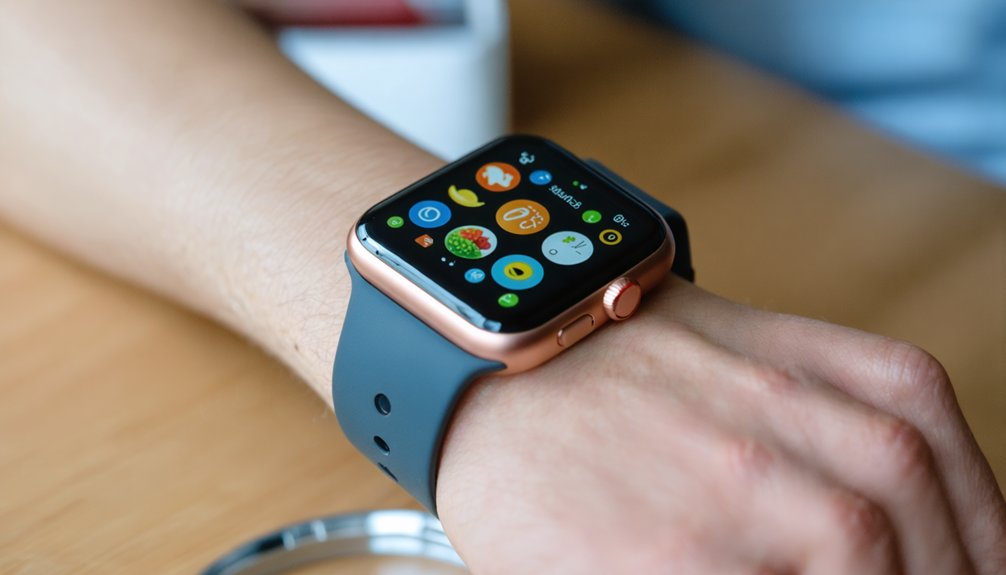

Your phone and wearables quietly log meals by combining camera images, wrist bio‑impedance and motion sensors, plus timestamps and optional glucose or heart data to detect eating, identify foods, and estimate portions and macronutrients. On‑device AI preserves privacy and gives instant feedback while cloud analysis yields higher accuracy and richer food databases. Accuracy falls with mixed dishes and poor reference images, so systems fuse multimodal signals and curated databases to improve estimates — keep going and you’ll learn how each piece fits together.
Key Takeaways
- Wearable cameras capture meal images and use AI to identify foods and estimate portions for calorie and macronutrient tracking.
- Wrist or chest sensors detect eating gestures and impedance changes to infer meal times and eating behaviors passively.
- On-device AI performs fast, private meal detection and simple nutrient estimates; cloud processing enables higher-accuracy, multi-step analysis.
- Matched food items link to regional composition databases to convert detected foods and portions into calories, protein, carbs, and fat.
- Accuracy is limited by mixed dishes, hidden ingredients, occlusion, and noisy sensors, so multimodal fusion and curated databases improve results.
Camera-Based Wearables: How Vision Powers Automatic Food Detection
Leveraging vision, camera-based wearables automatically document what you eat by combining strategically placed lenses with machine learning that isolates and identifies food items. You’ll see devices mounted at eye-level (AIM-2 with eye‑tracking) and chest or neck positions (eButton, SenseCam) chosen for wearable ergonomics and cultural fit. The pipeline first filters food‑exposure frames, then applies semantic segmentation and classification; EgoDiet’s 3DNet adds depth‑mapping to reconstruct containers and estimate portions via FRR and PAR metrics. Designers handle occlusion handling and motion blur by capturing multiple frames and using wide‑angle views, though that raises detection complexity. Systems balance on-device triggers versus continuous capture to reduce storage and privacy burden, giving you trustworthy, community‑validated insights into eating events without extra user effort. Field studies in London and Ghana demonstrated reduced portion-estimation error versus traditional methods, supporting real-world effectiveness. This approach has been evaluated in urban child populations in the Arab region to assess feasibility and acceptability. Recent research also shows that combining wearable cameras with automated tag-based image classifiers substantially lowers the need for manual review by human annotators, improving scalability and preserving privacy automated detection.
Bio‑impedance Sensors: Measuring Eating Events and Physiological Responses
While camera systems watch what you eat, bio‑impedance sensors listen to how your body and food interact electrically, letting wrist‑worn devices detect eating events and physiological responses with minimal user effort.
You’ll feel confident knowing electrodes placed in tetrapolar or bilateral wrist layouts capture idle impedance and then detect new parallel circuits when hands, utensils, mouth, and food create conductive paths.
Temporal impedance signatures let models distinguish cutting, biting, utensil vs. hand feeding, and drinking with high activity detection performance.
Dry or wet Ag/AgCl electrode placement supports continuous hydration tracking and correlates strongly with total body water changes.
Lightweight on‑device processing and validated metrics (e.g., 86.4% macro F1 eating detection) let you join a community using unobtrusive, evidence‑based monitoring while acknowledging current limits in food type classification.
The approach has been evaluated in realistic dining settings with multiple users, demonstrating real‑world performance. Additionally, studies show this wearable method can operate without instrumented utensils, offering a portable solution for everyday use.
Wearable bioimpedance is seen as a promising option for chronic condition monitoring because it is noninvasive and versatile.
On‑Device AI Vs Cloud Processing: Where Nutritional Analysis Happens
Having wrist bio‑impedance reliably detect eating events raises the question of where the heavy lifting of nutritional analysis should occur: on the device you wear or in remote servers.
You’ll weigh trade‑offs: on‑device edge computing keeps sensitive eating and metabolic data local, supports privacy preserving models, eliminates latency and enables instant feedback for behavioral change. But your wearable’s battery, thermal limits and reduced compute mean models are quantized or pruned, sometimes sacrificing accuracy.
Cloud processing lets you leverage full CNN/LSTM architectures, large training sets and centralized syncing across platforms, yet it increases network exposure and regulatory complexity (HIPAA, GDPR). Many real‑world systems also integrate food recognition to automate logging using vision AI.
Choose based on priorities: if belonging to a community that values privacy and immediacy, favor edge; if you need highest‑accuracy batch analysis, rely on cloud.
AI models can also integrate continuous glucose monitor data to personalize recommendations in real time. Integrating data from wearables, regional food databases and clinical records enables more tailored guidance for diverse populations and clinical use cases regional databases.
From Image to Macronutrients: Algorithms for Food Identification and Estimation
Start by recognizing that turning a photo into a macronutrient breakdown rests on two tightly coupled problems: identifying what’s on the plate and estimating how much of it there is.
You rely on deep learning—image classification and object detection models like YOLOv8xl combined with instance segmentation—to perform robust food recognition across cuisines and languages. Training sets span branded, restaurant, and regional dishes, and kernel fusion captures color, texture, and scale features.
For portion estimation you’ll see multi-angle 3D reconstruction, depth sensing, elliptical plate fits, and point completion networks to handle occlusion.
Once identified and measured, systems match items to regional composition databases to compute calories, protein, carbs, and fat, delivering results in seconds with community-trusted accuracy metrics. AI-driven photo-based tracking also reduces the manual entry burden that caused high abandonment rates in early digital trackers.
Integration With Health Ecosystems: Combining Nutrition With Activity and Sleep
Converting a meal photo into macronutrients is only half the story — to understand how that intake affects your health you need to connect it with activity and sleep data from the devices you already wear. You’ll benefit when ecosystem interoperability funnels nutrition, wearable activity, and sleep metrics into centralized hubs like Apple Health or Health Connect, removing app-switching and delivering longitudinal insights across days, months, and years.
Partnerships—Lifesum with ŌURA, glucose monitors with nutrition platforms—let you see how late meals alter sleep or how poor rest drives calorie choices. When RPM and EHR integrations add wearable streams to clinical records, clinicians can tailor interventions using continuous baselines. That connected view helps you and your community make informed, sustained lifestyle changes.
Accuracy Challenges: Mixed Dishes, Portion Sizes, and Data Limitations
While smart nutrition tools promise convenience, they still stumble on core accuracy issues that affect actionable insights: AI struggles to parse mixed dishes, visual portion estimates remain error-prone, and inconsistent databases and user input introduce further noise.
You’ll notice AI models misclassify overlapping ingredients in curries or composite meals, producing divergent protein and fat estimates versus USDA benchmarks.
Reference imaging and label standardization portion size aids help, but segmentation errors and limited cuisine training reduce reliability.
Apps vary—some match manufacturer data sporadically—while crowdsourced entries and manual logs add noise.
You’ll want tools that combine reference imaging, clearer portion guides, and stricter database curation, because without those fixes your daily nutrition picture will stay imprecise and fragmented.
Privacy and Data Handling: Image Deletion, Consent, and Secure Processing
Fixing accuracy gaps won’t matter if your data ends up exposed or misused: images of meals, timestamps, and linked biometrics can reveal habits, health conditions, and even locations when combined with other datasets.
You should expect platforms to offer consent granularity so you choose which images, timestamps, or biometrics get shared, and for what purpose.
Demand clear retention policies and secure retention mechanisms—local storage and on-device processing reduce exposure, while end-to-end encryption and anonymization guard cloud backups.
Regulators lag, so ethical stewardship matters: readable “privacy nutrition labels,” explicit opt-ins, and easy deletion controls should be standard.
When services link across vendors, insist on minimized third-party access and verifiable deletion to keep your community’s trust intact.
Practical Trade‑Offs: Battery Life, Usability, and Real‑World Benefits
If you want a tracker that actually fits your life, you’ll need to weigh clear trade‑offs between battery, features, and everyday convenience.
You’ll face battery tradeoffs: budget bands (Fitbit Inspire 3, Amazfit Band 7) give week+ runtimes but skip built‑in GPS, while premium watches (Forerunner 265S, Garmin Instinct 2X Solar) stretch days or even weeks with solar support yet plummet to 13–60 hours with active GPS.
Usability compromises matter too: slim designs or constant GPS force frequent charging that fragments sleep and nutrition logging, and app ecosystems can lock you in or complicate data sharing.
Decide whether continuous, accurate tracking outweighs extra charging, platform limits, or subscription fees to keep your health data useful and belonging intact.
References
- https://therecursive.com/building-better-eating-habits-with-the-drop-the-world-s-first-fully-automated-wearable-nutrition-tracker/
- https://www.nature.com/articles/s41598-024-67765-5
- https://www.foxnews.com/tech/food-tracking-just-got-lazy-best-way-possible-wearable
- https://parolaanalytics.com/blog/food-tracking-apps/
- https://newatlas.com/diet-nutrition/nutrition-tool-drop/
- https://www.todaysdietitian.com/performance-nutrition-and-wearable-trackers/
- https://www.troopmessenger.com/blogs/tech-tools-and-smart-nutrition
- https://www.qina.tech/blog/wearable-technology
- https://pmc.ncbi.nlm.nih.gov/articles/PMC12069382/
- https://healbe.com