
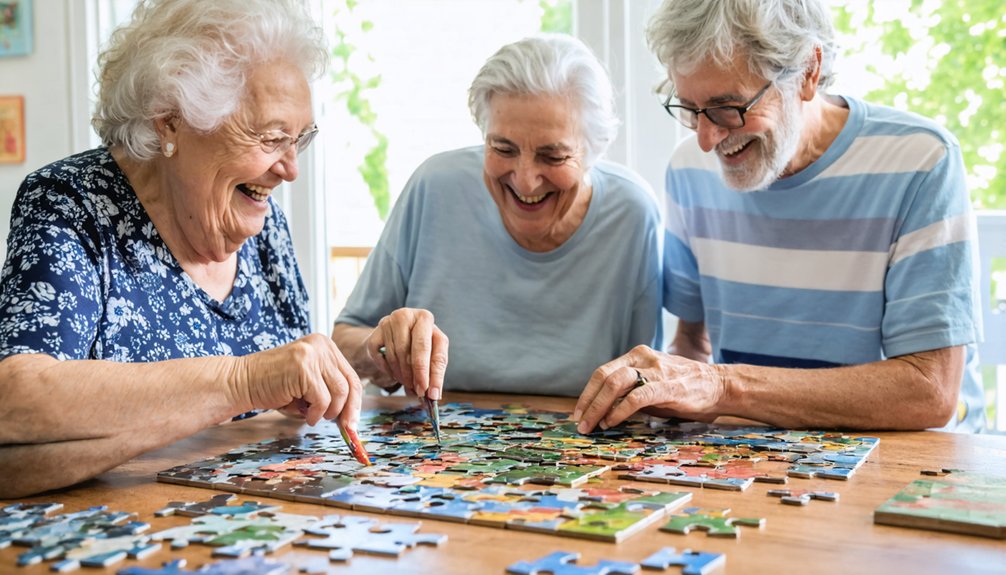

Staying socially active protects your thinking by giving your brain regular challenge, emotional support, and stress relief. Engaging with diverse people and roles builds cognitive reserve, keeps neural circuits flexible, and can slow measurable decline or lower dementia risk. Close listening and supportive ties buffer cortisol, reduce inflammation, and boost hippocampal resilience. Group activities and meaningful routines reinforce memory and mood, while cultural and gender patterns shape how benefits show up — keep going to learn practical ways and mechanisms.
Key Takeaways
- Regular social engagement slows global cognitive decline and lowers dementia risk by strengthening mental stimulation and preserving cognitive function.
- Diverse, supportive networks build cognitive reserve by offering novel challenges, listener support, and varied roles that enhance neural resilience.
- Social connections reduce stress hormones and inflammation, protecting hippocampal neurons and supporting memory and learning.
- Maintaining community ties and frequent interactions predicts stable cognitive trajectories and signals lower risk of future decline.
- Addressing social withdrawal and related depressive symptoms can partially prevent accelerated cognitive decline and improve mental health.
The Link Between Social Engagement and Cognitive Decline
Although social ties might seem peripheral to brain health, robust evidence shows they substantially slow cognitive decline.
You’ll see measurable benefits: frequent social activity cuts global decline rates dramatically—up to 70% for highly active people—and each point increase in activity score reduces annual decline substantially.
Studies link greater community density and richer network diversity to lower dementia risk (30–50%) and slower loss across multiple cognitive domains.
Social frailty, by contrast, raises dementia risk by almost half in older adults.
Mood and stress pathways partly explain this: better engagement lowers depression and buffers stress, supporting vascular and neural health.
Keep diverse, dense social contacts—formal groups, varied activities, tech connections—to protect cognition over time.
Recent longitudinal research using nationally representative data indicates that declines in social engagement are associated with measurable drops in cognitive performance over four years, with changes in depressive symptoms explaining part of this effect 15.3%.
New evidence from a long-term cohort shows that greater social activity is linked to significantly slower cognitive decline over more than a decade. Additionally, higher levels of social support are associated with better maintenance of memory and executive function in older adults.
How Social Connections Build Cognitive Reserve
When you stay socially engaged, your brain doesn’t just enjoy company—it builds resilience. You strengthen neural pathways and create new ones as you navigate varied roles and conversations, so cognitive reserve grows from real-life challenge. Network diversity matters: bridging different groups and toggling contexts gives your mind flexible practice that dense, homogenous circles rarely provide. Practical listening—the simple fact that someone’s there—has outsized effects; listener availability links to markedly lower dementia risk and helps maintain function despite brain changes. You can boost reserve through varied social activities, complex roles, and consistent opportunities to be both supported and challenged. Measuring progress uses education, occupation, and leisure as proxies, but the core is clear: diverse, attentive connections protect your cognition. Recent studies also show that amygdalar volume relates to cognition and that network diversity can moderate this relationship. A large population study found that supportive listening availability was associated with better cognitive performance than expected for individuals with smaller cerebral volumes. Communities that promote social connection can lower dementia risk by addressing isolation and building social support.
Biological Pathways: Stress, Hormones, and the Hippocampus
Because your social world shapes biological stress systems, staying connected directly affects hormones, inflammation, and hippocampal integrity.
You benefit when social support normalizes cortisol rhythms, preventing chronic cortisol elevations that damage neurons and fuel inflammation tied to dementia risk.
Connection speeds cortisol recovery after stress, preserves glucocorticoid receptor sensitivity, and reduces interleukin-6 and C-reactive protein.
Bonding boosts oxytocin, which calms HPA responses, lowers inflammation, and promotes oxytocin plasticity that supports synaptic repair and resilience in the stress hippocampus.
Social engagement also stimulates noradrenergic systems, enhancing attention and plasticity that reinforce hippocampal circuits.
In short, your relationships aren’t just comforting — they modify hormones and cellular pathways to protect hippocampal structure and cognitive function as you age.
Expansive, diverse social networks may build cognitive reserve that helps preserve function despite brain changes.
Social activities that involve novel, reciprocal interaction also engage social playfulness.
Engaging in creative pursuits as part of social interaction can further strengthen these effects by promoting neural resilience.
Types of Social Activities That Protect the Brain
Social activities come in many forms, but not all are equal in protecting your brain: group volunteering, religious services, informal peer contact, structured leisure, and broader community participation each offer distinct cognitive benefits.
You’ll find group volunteering and intergenerational programs linked to slower decline, delayed dementia onset, and better spatial memory—real-world purpose that strengthens cognition.
Regular religious services boost neural efficiency and buffer stress, while informal peer interactions give immediate, short-term test gains and reinforce memory binding through emotional connection.
Structured leisure—travel, arts, games—keeps flexibility and can translate into large lifetime healthcare savings.
Broad community participation builds identity and sustained cognitive reserve.
Mix activities, including virtual meetups when needed, so you get both depth and variety to protect your brain.
Recent smartphone-based research shows that more frequent, pleasant social interactions are associated with better cognitive performance on the same day and for up to two days afterward, highlighting that even short-term increases in social contact can boost cognition short-term benefits.
Gender Differences in Social Engagement Benefits
Although men and women both gain cognitive protection from staying socially engaged, the specific benefits and optimal activities differ by gender. You’ll find that women often build cognitive reserve through gendered leisure and intellectually rich social pursuits, which boost verbal ability and executive function; men tend to gain memory and processing-speed advantages from role shifts, occupational skills, and domestic activity continuity.
When designing engagement plans, use activity tailoring: prioritize intellectual-cultural groups and longer-duration, low-intensity exercise for many women, and incorporate structured self-improvement, spatial challenges, and consistent domestic tasks for men. Peer mentoring and mixed-gender networks can bridge gaps, offering shared stimulation and belonging. Effective interventions respect these patterns, employ gender-stratified evaluation, and foster inclusive, adaptable participation opportunities.
Cultural and Racial Variations in Social Activity Effects
When you look across racial and cultural groups, patterns of social engagement and their cognitive effects diverge in ways that matter for both research and intervention. You’ll notice Non-Hispanic White older adults often report more out-of-home activities and volunteering, linked to memory gains, while Black and Hispanic elders report stronger ties to close children and extended family.
Structural barriers — safety, transport, economic strain — and measurement blind spots limit access to culturally meaningful engagement like community rituals and intergenerational storytelling. That means social connections can protect cognition for some but burden others. You should design interventions that honor cultural definitions of meaningful interaction, reduce structural obstacles, and measure engagement types that truly reflect belonging across racial and ethnic communities.
Social Engagement and Trajectories of Cognitive Impairment
Building on how cultural contexts shape who people connect with and how they engage, we now look at how patterns of social involvement map onto long-term cognitive courses.
You’ll see from longitudinal clustering and trajectory modeling that distinct groups recur: low-decline, medium-decline, and high-stable trajectories.
Maintaining social engagement — especially community and relational integration — raises odds of a high-stable course and lowers odds of low-decline.
Declines in engagement predict measurable drops in global cognition and increase depressive symptoms, which partially mediate accelerated decline.
Quantitatively, greater social integration increased likelihood of favorable trajectories, while each standard-deviation engagement decline predicted cognitive loss.
These findings give you a reliable framework: engage socially to shift your trajectory toward stability, backed by repeated longitudinal evidence.
Practical Ways to Increase Social Engagement for Brain Health
To strengthen your brain through social engagement, pick practical, sustainable steps that fit your life and interests. Choose a mix of structured groups—senior centers, faith communities, volunteer teams, sports clubs, or political groups—to combine mental challenge and social contact. Use community calendars to find diverse events and rotate activities to build cognitive reserve.
Add daily routines: shopping with a friend, neighborhood gardening, or family conversations that practice memory and language. If mobility’s a barrier, arrange transport solutions or try video calls and online interest groups to stay connected. Start small, commit weekly, and vary formal and informal interactions.
Your consistent, varied social life becomes a dependable source of belonging and brain protection.
References
- https://pmc.ncbi.nlm.nih.gov/articles/PMC11671422/
- https://www.nature.com/articles/s41598-021-95438-0
- https://pmc.ncbi.nlm.nih.gov/articles/PMC10034713/
- https://www.alzinfo.org/articles/prevention/the-wide-ranging-benefits-of-social-engagement/
- https://www.frontiersin.org/journals/public-health/articles/10.3389/fpubh.2021.750340/full
- https://depts.washington.edu/mbwc/news/article/social-connection-and-brain-health
- https://www.medstarhealth.org/blog/sense-of-purpose-cognitive-decline
- https://alz-journals.onlinelibrary.wiley.com/doi/10.1002/alz.14316
- https://pmc.ncbi.nlm.nih.gov/articles/PMC3206295/
- https://www.nature.com/articles/s43587-023-00387-0