
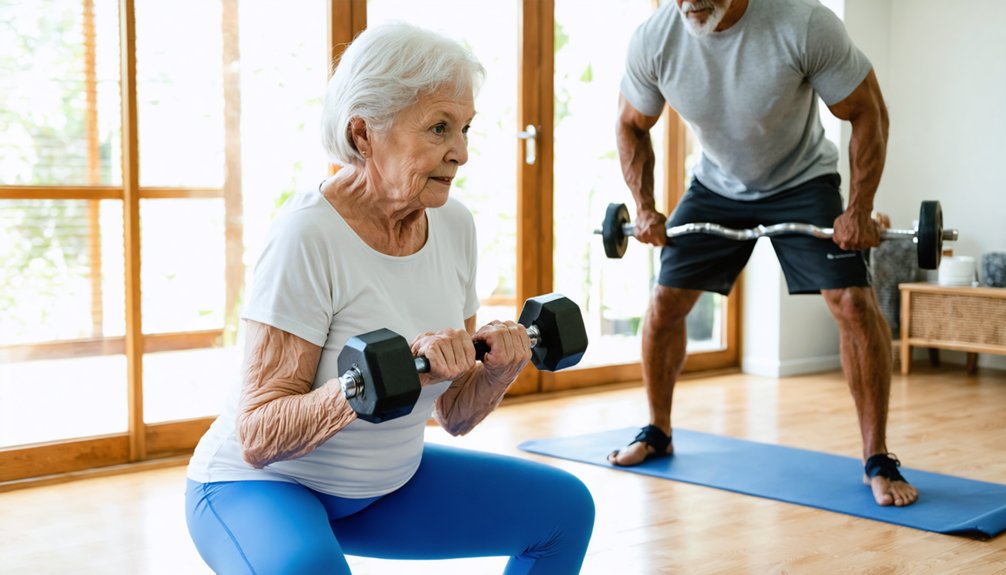

You can stop the slide in strength with regular, progressive strength training: it rebuilds muscle size and quality, restores motor unit recruitment and firing rates, lowers frailty risk, and improves balance and power for safer daily movement. Lifting stimulates bone at loaded sites, boosts neuromuscular coordination before big size changes appear, and works best with adequate protein and consistent progression. Keep going for clear, practical guidance on how to start and progress safely.
Key Takeaways
- Strength training preserves and increases muscle fiber size and number, slowing age‑related atrophy and fat/fibrosis replacement.
- Progressive heavy loads boost myofibrillar density and strength, improving daily function and reducing fall risk.
- Resistance work enhances neural drive, motor unit recruitment, and rate of force development before hypertrophy occurs.
- Regular strength training stimulates bone formation and tendon stiffness, increasing skeletal resilience and fracture resistance.
- Combined with ~1.2 g/kg/day protein and sensible timing, resistance training maximizes repair and reverses frailty.
Why Muscle Loss Accelerates With Age
Because multiple systems change as you age, muscle loss accelerates through interconnected biological processes that weaken muscle maintenance and repair.
You’ll notice reduced muscle fiber size and number—about 3–8% loss per decade after 30, accelerating after 60—while tissue is replaced by fat and fibrosis.
Hormonal decline (lower testosterone, growth hormone, IGF‑1) cuts protein production and impairs repair, especially between 65–80 when losses steepen.
Neuromuscular deterioration and denervation reduce precise activation, causing further fiber loss.
Chronic low‑grade inflammation and mitochondrial dysfunction lower ATP production and enzyme activity, undermining cellular energy for maintenance.
Nutritional and anabolic resistance make protein less effective, limiting recovery.
Together, these processes create predictable vulnerabilities you can acknowledge and address with informed strategies. Increased physical activity and targeted resistance training remain effective because muscle remains responsive at any age. Sarcopenia prevalence increases with advancing age. Current evidence shows that resistance exercise reliably improves muscle strength and function in older adults.
How Resistance Training Rebuilds Strength
Start resistance training and you’ll directly reverse many age-related declines by remodeling muscle and neural systems to produce more force and power. You’ll increase muscle thickness and myofibrillar density, tighten filament packing, and refine muscle architecture—changes that translate to measurable strength gains (large SMDs for overall and bench press strength). Resistance training produces both neural adaptations and hypertrophy, contributing to early and sustained strength increases, with pooled analyses showing a robust effect on maximal strength SMD ≈ 0.77. With consistent, progressive loads and adequate rest (three to five minutes), you’ll maximize myofibrillar synthesis and 1RM improvements. Protocols using moderate sets, 8–10 reps, and ≤25% velocity loss optimize strength, while daily undulating periodization boosts volume and bench outcomes. As your muscles adapt, increased tendon stiffness and optimized pennation angles speed late-phase force development, helping you move confidently and belong to a community committed to resilient aging. These effects are influenced by training status, so individuals with different histories may experience different magnitudes of adaptation. A rigorous 10-week resistance program with monitored progression and detraining phases showed that no participant was a total non-responder across a full training period, highlighting the role of training consistency in producing measurable muscle growth.
Neurological Changes Driven by Strength Work
When you lift heavy and push progressive loads, the nervous system adapts quickly and often accounts for early gains in strength and power more than muscle size does.
You’ll experience neural plasticity: improved motor unit recruitment, firing rates, and reorganization that restore function lost with age.
You’ll also see rapid improvements in movement efficiency from enhanced neuromuscular coordination and reflex responsiveness, especially when training focuses on high intent and load 80%–90% 1RM.
Strength training boosts efferent neural drive more than unloaded or recreational activity, reversing declines in rate of force development that outpace muscle mass loss.
Motor synchronization improves so surviving motor units coordinate faster and more effectively, reducing dynapenia even before sizable hypertrophy appears.
These adaptations link to cortical changes and cognitive benefits, creating a sense of shared progress—you’re not just rebuilding muscle, you’re re-tuning the nervous system to keep you strong, capable, and connected.
Resistance exercise also raises circulating levels of BDNF, which supports neuroprotection and cognitive function.
This neural preservation is supported by studies showing resistance training can maintain neurometabolite levels in regions like the sensorimotor cortex preservation of SM1 metabolites.
Optimal Training Intensity and Frequency for Older Adults
To get the most from strength work as you age, aim for 2–3 sessions a week with at least 48 hours of recovery between hard workouts. You’ll see meaningful gains with two nonconsecutive days, and adding a third can boost results if you manage recovery monitoring. Train largely in the 60%–85% 1RM range for muscle and strength improvements; consider heavier loads (≥80% 1RM) for maximal strength and neural benefit, progressing toward them gradually. Use 1–3 sets per muscle group, 8–15 reps, and apply progressive overload by increasing load, reps, or sets across weeks. If you start frail, begin at low intensities (20%–30% 1RM) and advance steadily. Track fatigue, sleep, and soreness to guide safe progression. Older adults also experience loss of muscle fibers, which strength training can help counter.
Rapid Functional Gains: Power, Balance, and Daily Tasks
Having settled on the right intensity and frequency, you can shift focus from pure strength to functional power, balance, and everyday tasks—areas where gains often appear faster and matter more for independence.
You’ll see muscle power improve sooner than maximal strength, and targeted power drills with task specificity translate that speed into safer, quicker movement. In just six to eight weeks, timed-up-and-go, chair rise time, gait speed and walking distance can improve meaningfully, even in people in their 80s and 90s.
Functional resistance work boosts rate of force development, trunk and leg control, and neuromuscular coordination, all reducing fall risk. You belong to a group that practices transferable, measured progress—training that protects mobility and daily autonomy.
Bone Health and Fracture Prevention Through Lifting
With consistent, appropriately loaded resistance work you can actively slow — and in some cases reverse — age‑related bone loss by stimulating bone formation and structural reinforcement. You create targeted bone adaptation: mechanical strain from muscle contractions activates osteoblasts, increasing mineralization where you load the skeleton.
Protocols using moderate‑to‑heavy loads (50–80% 1RM), multi‑joint moves like squats and deadlifts, and three weekly sessions produce measurable BMD gains in the lumbar spine and hip within months. Those site‑specific improvements translate into greater mechanical strength and improved fracture resilience, lowering osteoporosis‑related risk.
Even well‑designed lower‑load, higher‑rep plans work if progressive. Train with peers or a coach for safety and consistency; you’ll gain not just stronger muscles but a more fracture‑resistant skeleton.
Combining Diet and Exercise to Reverse Frailty
Combine targeted resistance training and adequate protein intake and you’ll get the strongest evidence for reversing frailty in older adults.
You’ll see measurable gains: better SPPB scores, reduced Fried frailty scores, and an 11.9% absolute risk reduction for frailty reversal when exercise and dietary protein are combined.
Aim for ~1.2 g/kg protein daily and sensible protein timing around workouts to maximize muscle repair.
Programs that pair short daily strength work with once-weekly group sessions show stronger outcomes and meaningful strength increases.
You won’t do this alone — community programs and group delivery boost adherence, provide social support, and make implementation feasible.
With guidance and consistent effort, you can substantially lower your odds of frailty and feel stronger within months.
Practical, Low-Barrier Strength Routines for Busy Seniors
Frequently, the best way to fit strength training into a busy life is to pick short, high-impact sessions you can actually stick to: aim for 10–30 minutes of focused resistance work two to three times a week that targets all major muscle groups, uses bodyweight or simple portable resistance (bands, vests, household items), and progresses in intensity over time.
You’ll get measurable gains—each session can improve muscle power 0.5–1% and short programs increase fiber length and tendon stiffness.
Use chair workouts for safe, accessible options; add weighted vests or bands to progress. Join community classes or small groups to build consistency and belonging while benefiting from supervision.
Prioritize mixed sessions that include balance and functional moves so strength translates to daily independence and lower fall risk.
References
- https://journals.physiology.org/doi/full/10.1152/physiol.00044.2018
- https://pmc.ncbi.nlm.nih.gov/articles/PMC3117172/
- https://www.nia.nih.gov/news/how-can-strength-training-build-healthier-bodies-we-age
- https://utswmed.org/medblog/age-related-sarcopenia/
- https://baptisthealth.net/baptist-health-news/age-related-muscle-loss-what-to-know-about-sarcopenia
- https://pmc.ncbi.nlm.nih.gov/articles/PMC6202460/
- https://pmc.ncbi.nlm.nih.gov/articles/PMC2804956/
- https://www.webmd.com/healthy-aging/sarcopenia-with-aging
- https://my.clevelandclinic.org/health/diseases/23167-sarcopenia
- https://medicine.tufts.edu/news-events/news/muscle-loss-older-adults-and-what-do-about-it