

You can use simple, affordable tech—wearables, smart-home sensors, telehealth, and apps—to monitor vital signs, detect falls, remind you about meds, and connect you with clinicians or loved ones. These tools give real-time alerts, support therapy at home, and automate daily tasks so you can stay safe and independent longer. Evidence shows better adherence, fewer hospital visits, and improved mobility and mood. Keep going and you’ll find practical options and tips to fit your needs.
Key Takeaways
- Remote health monitoring and telehealth enable continuous vitals tracking, early intervention, and virtual clinician visits from home.
- Medication-management tools (smart pillboxes, apps, pharmacy telehealth) reduce missed doses and harmful drug interactions.
- Fall-detection systems and smart-home sensors quickly alert responders and automate safety features like lighting and door locks.
- Communication technologies (video calls, social apps, digital companions) reduce isolation and support mental stimulation.
- Home automation and accessibility tech (voice control, smart plugs, reminders) simplify daily tasks and preserve autonomy.
Health Monitoring and Remote Care
Start by recognizing how health monitoring and remote care keep older adults safer and more independent: more than half of U.S. seniors 55+ now use health-related technology, with 64% relying on telehealth and 71% using health‑tracking apps to monitor conditions.
You’ll find blood pressure monitors, fitness trackers, and wireless wristwatch devices that collect continuous measurements and activity data, helping you and your care circle spot changes early. By 2030, older adults will comprise more than 20% of the U.S. population, which underscores the growing need for supportive technologies. Studies show that older adults can and will use home monitoring systems over extended periods, demonstrating feasibility of long-term monitoring. Research with older adults shows many use monitoring tools to manage chronic conditions.
Machine-learning and predictive analytics flag deviations from long-term patterns, supporting tailored care plans and timely medication adjustments.
With strong adherence rates and real-time oversight, these tools let you maintain independence while staying connected to clinicians and caregivers.
The evidence shows technology improves chronic condition management and fosters a shared sense of safety and belonging.
Fall Detection and Emergency Response Systems
While no system is perfect, fall detection and emergency response technologies give you an automatic safety net that can cut response times and reduce hospitalizations.
You’ll find options from wearable pendants and chest-worn accelerometers to ambient sensors, smart carpet pressure pads, and camera-based systems — each with documented accuracy metrics (many studies report sensitivities and specificities above 90%). Studies vary in testing rigor across lab and real-world settings. Sensor fusion has been shown to improve robustness in many studies.
Trunk-centered and multi-sensor designs tend to balance high detection with low false alarms, preserving trust.
Implementation hinges on proper sensor placement, reliable Bluetooth/Wi‑Fi/GPS links, and clear notification chains to caregivers or emergency services.
Evidence shows facilities using these systems see fewer falls and hospitalizations.
Choose solutions aligned with your comfort and community needs to strengthen independence and shared safety.
One out of four older adults aged 65 and older falls each year, underscoring the widespread need for these technologies.
Tools for Combating Social Isolation
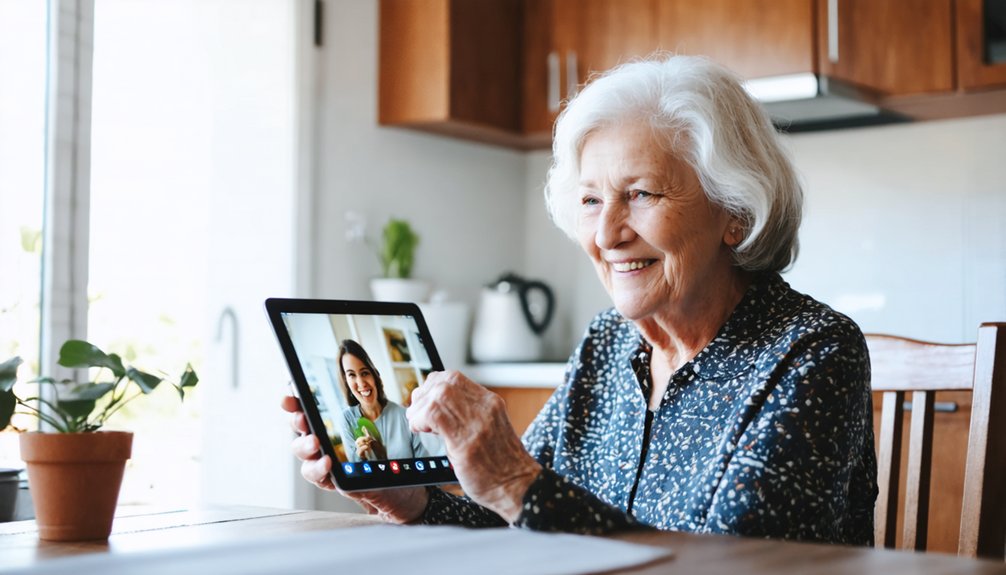
Frequently, technology provides practical ways to reduce isolation and keep you connected to friends, family, and community activities. You can use videoconferencing and Wi‑Fi tablets—shown to improve mood during pandemic interventions—to sustain relationships and join virtual clubs. Digital companions and AI chatbots offer conversational support, reminders, and activity prompts that complement human contact without replacing it. Community kiosks and touch‑screen stations extend access where broadband or personal devices are limited, linking you to classes, telehealth, and social events. Training programs and volunteer facilitation improve uptake, and flexible delivery suits homebound participants. Evidence supports benefits but remains limited by study quality, so monitor outcomes and preferences. Prioritize accessible design and broadband access to maximize social, emotional, and health returns. Newer in‑home technologies such as voice assistants and sensors can also reduce loneliness and support aging at home by monitoring daily activity and prompting engagement reduced loneliness. Research shows that general information and communication technologies are the most commonly applied interventions in studies of older adults’ social connectedness general ICT. Approximately one-third of older adults report loneliness and social isolation, highlighting the importance of these tools.
Smart Home Solutions for Daily Living
Built into your home, smart technologies can make daily tasks easier, safer, and more energy‑efficient while supporting independence.
You’ll find voice control simplifies interactions—letting you adjust lighting, lock doors, or call for help without fumbling or moving.
Appliance automation with smart plugs and schedules runs coffee makers, heaters, and fans when you need them, conserving energy and reducing chores.
Integrated hubs learn routines and coordinate sensors to detect falls, monitor movement patterns, and trigger motion‑activated lighting to prevent nighttime trips.
These systems connect you with caregivers or community staff via two‑way communication when issues arise.
Knowing neighbors and staff can support setup and troubleshooting fosters belonging, while targeted programs and concierge services address cost and accessibility barriers so you can adopt with confidence.
Many older adults’ decisions about adopting these technologies depend on factors like income capacity.
Medication Management and Adherence Support
Managing medications at home can feel overwhelming, but technology is making it more accurate and easier to stick to your regimen. You can use electronic pillboxes, smartphone apps, and smart medication tracking to get timely reminders and reduce missed or duplicated doses—systematic reviews show these tools boost adherence.
Pharmacy telehealth connects you with pharmacists for video reviews, reconciliation, and medication therapy management that cut inappropriate prescriptions and adverse drug reactions.
Shared electronic medication plans and computerized decision support improve prescribing accuracy and help your care team, family, and you stay aligned.
While adoption varies, satisfaction is high among users, and telephone follow-up plus electronic records further enhance safety—so you’re supported, connected, and less likely to face medication errors.
Technology-Assisted Rehabilitation and Mobility
Tap into technology to keep your mobility strong and reduce fall risk: evidence from multiple randomized trials and meta-analyses shows that tools like exergaming with motion capture and virtual reality deliver meaningful improvements in balance, gait, and functional mobility compared with no treatment and often match or exceed traditional therapy.
You’ll find exergaming adoption can boost motivation and adherence through gamified, personalized routines that target balance and gait.
Wearable feedback and inertial sensors give real-time cues and objective data for therapists to tailor plans, whether in clinic or via telehealth.
These approaches reduce fall risk, maintain independence, and expand access for those who can’t travel.
You belong to a growing group reclaiming mobility with proven, user-centered tech.
Cognitive Support and Mental Health Tools
Although cognitive aging is common, technology can markedly preserve thinking and independence: large meta-analyses show users have about a 58% lower odds of cognitive impairment even after accounting for education and health, and benefits appear across computers, smartphones, and internet activities.
You can use digital stimulation—problem-solving interfaces, online learning, and social platforms—to build resilience: persistent engagement parallels brain-game benefits and links to lower decline over years.
Digital scaffolds like medication reminders, bill alerts, GPS, and online banking preserve daily function and delay dependence.
Mood apps and teletherapy offer accessible mental-health support, though adherence varies and design must fit vision, hearing, and dexterity needs.
Join others who use these tools; with tailored support, you’ll keep autonomy and stay connected.
Transportation and Errand Services for Independence
Getting where you need to go is central to staying independent, and technology-driven transportation and errand services are making that practical for more older adults.
You can use apps and digital scheduling to book community shuttles, NEMT, or on-demand rides with real-time GPS tracking so family and providers monitor trips. Data analytics and route optimization reduce service gaps, while partnerships with healthcare providers cut missed appointments — a key problem for about 4 million people yearly.
Evidence shows no-cost-ride programs boost social visits and quality of life, and services like grocery delivery preserve daily independence.
Federal programs and certified driver training improve safety, and targeted planning addresses rural and micropolitan gaps so you stay connected, mobile, and included in your community.
References
- https://summit-education.com/blog/general/empowering-aging-how-technology-enhances-independence-and-safety-for-older-adults/
- https://pmc.ncbi.nlm.nih.gov/articles/PMC11545332/
- https://aging.jmir.org/2023/1/e43197/
- https://www.frontiersin.org/journals/public-health/articles/10.3389/fpubh.2024.1476916/pdf
- https://www.aarp.org/pri/topics/technology/internet-media-devices/aging-technology-agetech/
- https://health.citris-uc.org/wp-content/uploads/2023/04/July-2009-CTA-briefing-paper.pdf
- https://caringseniorservice.com/blog/benefits-of-technology-for-seniors/
- https://academic.oup.com/biomedgerontology/article/80/7/glaf086/8165380
- https://foxrehab.org/older-adult-technology-education-independence/
- https://www.i-jmr.org/2022/2/e39005