
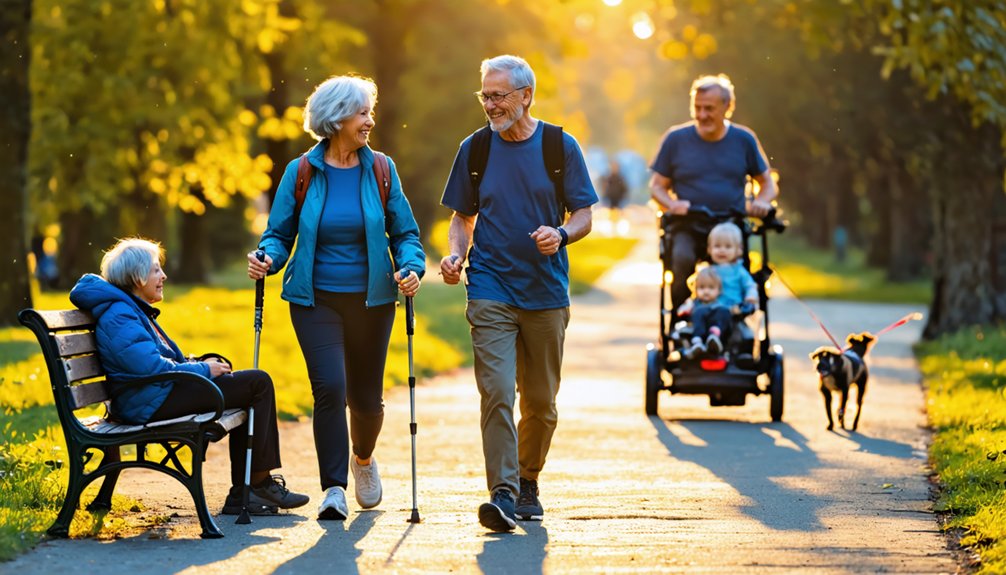

You can preserve independence, protect your brain, and lower chronic‑disease risk by keeping your body moving with strength, balance, and aerobic work. Regular activity cuts inflammation, preserves muscle and bone, sharpens thinking and mood, and slashes fall and hospital risk. Even starting late brings measurable gains within weeks. Environmental fixes, social supports, and targeted training help if mobility is limited. Keep going — the next sections explain practical steps and why they work.
Key Takeaways
- Maintaining strength, balance, and aerobic fitness preserves independence, reduces falls, and lowers chronic disease risk.
- Faster walking speed predicts longer life and reduced future hospitalization and disability.
- Regular multicomponent exercise (strength, balance, aerobic) yields measurable mobility and cognitive benefits even when started late.
- Cognitive health, especially executive function, directly affects gait stability and life‑space, linking mobility to dementia risk.
- Home and community environments, plus assistive technology and social supports, enable safer mobility and sustained participation.
Why Mobility Matters for Healthy Aging
Keeping your body moving is one of the most effective things you can do to age well: research links better midlife mobility with longer life and lower risk of chronic diseases, while regular mobility work—strength, flexibility, balance, and aerobic activity—improves circulation, reduces inflammation, preserves muscle and bone, and lowers your chances of heart disease, diabetes, several cancers, dementia, and disability. You’ll protect independence by building functional resilience: strength training counters age-related muscle loss, flexibility prevents everyday injury, and balance work cuts fall risk. Regular activity also boosts mood, sleep, and immunity, reducing hospitalization harms. Communities that prioritize movement equity make certain everyone can access safe programs and spaces, so everyone—regardless of background—can age with dignity, connection, and sustained function. Evidence shows even very late starters can gain measurable benefits from tailored programs, improving strength and mobility in weeks with consistent practice can improve mobility. In addition, simple self-report tools can help detect early changes so people get preventive support before major decline (early identification). A single session of moderate to vigorous activity can produce immediate benefits such as reduced anxiety and lower blood pressure.
How Common Are Mobility Limitations in Older Adults
Frequently, mobility limitations affect a large share of older adults: about 40% of people 65 and older reported at least one disability in 2008–2012, with walking or climbing difficulties the most common type.
You should know community prevalence varies by age and place: roughly 28% of those 65–79 have mobility limits, rising to nearly 71% for adults 80+.
Two-thirds of older adults with disabilities report mobility-related problems, and 9.6 million households include someone with mobility restrictions.
Device use reflects need and assistive adoption—22.2% of community-dwelling older adults use mobility aids (walkers, canes, wheelchairs).
Patterns differ by region, education, gender, and chronic disease burden, so your community’s context matters when planning support and inclusion.
Nearly 40 percent of people aged 65 and older had at least one disability, highlighting the scale of mobility-related challenges.
Research shows that mobility loss often signals broader health decline, including increased risk of hospitalization and reduced life-space, making it a key early indicator of vulnerability important predictor.
Adults with chronic diseases are more likely to be inactive, with those 50 and older and having at least one chronic condition showing higher inactivity rates than those without chronic disease.
Main Causes of Reduced Mobility With Age
Understanding the causes of reduced mobility with age helps you target prevention and care strategies. You face musculoskeletal degeneration—osteoporosis and arthritis weaken bones and inflame joints, while low muscle strength and degenerative disc disease reduce support and flexibility; obesity amplifies joint stress and creates a mismatch between body mass and musculoskeletal capacity. Neurological changes and neuropathy impact gait and balance: subtle central and peripheral nervous system declines, plus Parkinson’s, stroke, or Alzheimer’s, slow movement and increase variability. Chronic comorbidities—cardiovascular, respiratory, diabetes—further limit endurance and function. These interacting pathways explain why mobility loss is common and multifactorial. Recognizing the dominant contributors lets you seek coordinated medical, social, and rehabilitative supports tailored to your needs. Population studies show that walking speed is a strong predictor of future disability and survival. Regular exercise including resistance and weight-bearing activities reduces risk and helps maintain function, making exercise a key preventive measure. Research indicates that gait speed declines with age and is associated with higher mortality and hospitalization rates.
Physical Activity: Prevention and Management Strategies
Those biological and social drivers of mobility loss point directly to what works: regular, well-rounded physical activity prevents decline and treats many causes of reduced function.
You should aim for 150 minutes weekly of moderate aerobic activity plus muscle-strengthening and balance work; evidence shows this mix lowers mortality, cuts chronic disease risk, and reduces falls beyond average effects.
Join community classes to get social support and multitask physical, cognitive, and social demands.
Include challenging balance drills, progressive resistance, and coordination practice to protect bone and function.
Use wearable feedback to track intensity and adherence, helping you exceed minimal thresholds that yield 30–50% reductions in functional limitations.
Programs tailored to your needs optimize prevention and management across aging. Regular activity also supports cardiorespiratory fitness which predicts lower cardiovascular events and better executive function.
Cognitive and Psychosocial Factors That Affect Movement
Because thinking and moving share brain networks, declines in executive function, processing speed, and language skills often show up as gait variability, slower turns, and worse performance on dual‑task walking, putting you at higher risk of mobility limitations.
You should know executive dysfunction explains a meaningful share of complex mobility variance and raises mobility limitation risk by about 25–30%. Dual‑task cost increases 15–25% with cognitive decline, and language and processing speed strongly influence gait variability.
Life‑space restriction links to faster cognitive decline and predicts progression to MCI and dementia. Protecting cognitive reserves through engagement and meaningful activity preserves autonomy and slows decline.
Be aware social isolation impacts both cognition and movement; staying connected and cognitively active supports safer, more independent mobility.
The Role of Environment and Technology in Maintaining Mobility
In everyday settings, the physical and social environment shapes how well you move and stay independent as you age; features like terrain, postural changes, lighting, and seating can either enable or disable community mobility.
You benefit when sidewalks are even, lighting is adequate, handrails and seating are plentiful, and greenery or sheltered walkways reduce weather exposure—evidence links these features to less fear of falling and greater participation.
Where neighborhoods lack accessibility, you’re more likely to face confinement.
Technology complements design: smart pavements can detect hazards and guide routing, while assistive robotics support transfers and conserve energy during postural shifts.
Together, thoughtful environments and targeted technologies help you remain active, connected, and confident in your community.
Economic and Healthcare Impacts of Mobility Loss
When mobility falters, you and society pay—both in higher healthcare use from falls, injuries, and hospitalizations and in long-term financial strain that can push older adults into poverty or earlier institutional care.
You face measurable healthcare costs: musculoskeletal disorders alone drove US$96 billion in 2021, and mobility limits sharply raise fall and hospitalization risks.
Many people in their 70s–80s report restrictions, and disability often centers on walking or climbing. That translates to widespread economic hardship: most older adults endure years below the federal poverty level once health and long-term service spending are counted, with bottom earners far worse off.
Reduced mobility also drives earlier long-term care entry, strains pensions, and slows economic growth, so policy and community responses matter.
Adapting and Thriving: Strategies for Aging Well With Mobility Limits
The economic and health burdens of mobility loss highlight why practical strategies matter for individual quality of life and for society. You can adapt and thrive by combining evidence-based exercise, environmental changes, and social supports.
Aim for >43 minutes weekly of moderate activity and work toward structured multicomponent programs (walking, strength, balance) shown to cut major mobility disability. Use progressive resistance 2–3 times weekly and balance drills like single-leg stands.
Have an occupational therapist assess your home for grab bars, lighting, and non-slip surfaces; adaptive clothing and CAPABLE-style repairs support aging in place.
Engage peer support and health coaching to sustain goals, and try creative adaptations—seated balance, bands, step-ups—to keep routines practical, safe, and socially connected.
References
- https://pmc.ncbi.nlm.nih.gov/articles/PMC7522521/
- https://academic.oup.com/gerontologist/article/65/1/gnae087/7721691
- https://pmc.ncbi.nlm.nih.gov/articles/PMC10360303/
- https://www.cdc.gov/physical-activity/php/reports/adults-50-and-older.html
- https://www.ncoa.org/article/get-the-facts-on-healthy-aging/
- https://www.nature.com/articles/s41514-025-00245-w
- https://odphp.health.gov/our-work/national-health-initiatives/healthy-aging/social-determinants-health-and-older-adults
- https://jamanetwork.com/journals/jamanetworkopen/fullarticle/2815654
- https://www.coachingagingadults.com/aging-well-the-impact-of-mobility-exercises-on-lifespan/
- https://pmc.ncbi.nlm.nih.gov/articles/PMC3567319/