
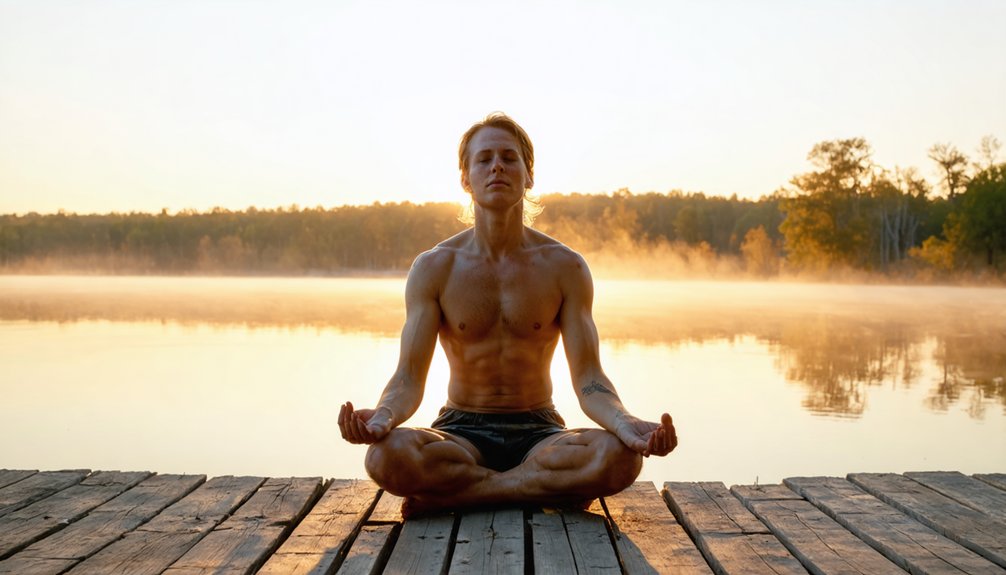

You’re getting faster relief because brief, paced breathing quickly shifts vagal tone, lowers sympathetic arousal, and boosts heart-rate variability—changes linked to reduced stress and better mood in randomized trials and meta-analyses (e.g., g=−0.35 across studies)1. Simple protocols like cyclic sighing, 4‑7‑8, or box breathing produce measurable mood and physiological gains in minutes to days, scale easily, and fit schools or clinics; keep going to learn which techniques match your goals.
Key Takeaways
- Breath training rapidly reduces stress and anxiety, with many trials showing measurable mood and physiological improvements after minutes to weeks.
- Slow and extended exhalation increases vagal tone and heart-rate variability, shifting balance toward parasympathetic calm.
- Specific techniques (cyclic sighing, 4-7-8, box breathing, SKY) map to distinct goals like mood boosts, quick anxiety relief, focus, or social connectedness.
- Five‑minute daily practices are low‑barrier, scalable, remotely deliverable, and produce clinically meaningful benefits and high adherence.
- Group delivery, habit‑stacking, and brief accountability improve uptake in schools, universities, and communities, extending mental‑health reach.
The Science Behind Breathwork’s Effects on Stress and Mood
Although the exact pathways are still being mapped, clinical research shows breathwork reliably lowers stress and improves mood: a meta‑analysis of 12 studies (785 adults) found a small-to-medium reduction in stress (g = −0.35, 95% CI −0.55 to −0.14), and 54 of 72 interventions across 58 clinical studies reported significant reductions in stress and anxiety.
You’ll see consistent mood gains and reduced respiratory and heart rates in trials; breathwork often outperformed mindfulness meditation (p < 0.05) and cut sympathetic activity while increasing parasympathetic tone. Mechanistically, practices that extend exhalation and slow breathing promote vagus activation and measurable heart‑rate slowing, linking to improved positive affect.
These physiological shifts may also support inflammation modulation, offering a biological route for symptom improvement. Clinical evidence is moderate risk but repeatedly points to real, shared benefits. Recent randomized trials also show that brief daily protocols can yield measurable improvements in mood and physiology, including reduced respiratory rate. Newer studies further indicate that breathwork can improve heart rate variability. A growing number of trials have demonstrated benefits across multiple populations, including clinical and nonclinical groups.
How Controlled Breathing Changes Brain and Body Communication
When you slow and shape your breath, you change how brain and body talk to each other: controlled breathing strengthens bidirectional signaling so that both cortical activity predicts heart-rate shifts and cardiac signals feed back to alter brain rhythms (Heck et al., 2017; Kluger et al., 2023).
You’ll notice nasal entrainment links respiration to widespread neural oscillations, synchronizing alpha and gamma bands and enabling prediction propagation of interoceptive signals across cortex.
That synchronization lets preBötC outputs engage locus coeruleus and brainstem hubs, boosting heart–brain coupling and HRV while lowering autonomic volatility. Increased synchronization is especially evident during slow, paced breathing around 0.05–0.06 Hz. Observations from recent studies indicate this effect can occur after brief practice sessions, often within minutes, supporting a role for rapid modulation. Recent research also shows that such practices can improve emotion regulation by altering predictive models of bodily state through interoceptive updating.
Which Breathing Techniques Deliver the Biggest Benefits
Comparing techniques helps you pick the breathing practice that best meets your goals: for boosting day-to-day positive affect and sustained slower breathing, cyclic sighing showed the largest gains in a 30-day Stanford trial (n=111) with cumulative mood benefits and reduced anxiety; SKY Breath Meditation—a multimodal program tested at Yale (n=135)—produced broad improvements across depression, stress, mindfulness, positive affect, and social connectedness; the 4-7-8 method offers rapid parasympathetic engagement useful for anxiety and sleep support; and box breathing gives a simple, performance-ready template for focus and physiological calm in high-pressure moments. The Stanford study was conducted remotely during the pandemic, enabling broader and more diverse participant reach and daily self-reported measures were collected before and after exercises via online questionnaires, showing that the interventions were feasible to deliver remotely to healthy volunteers. You’ll choose based on outcome: pick cyclic sighing to raise everyday positive affect and lower baseline anxiety; adopt SKY Breath for broad wellbeing and social connection; use 4-7-8 for quick anxiety relief or sleep; use box breathing for task-focused calm. An eight-week Yale classroom trial also found that SKY Campus Happiness led to multiple wellbeing gains and may be a scalable resiliency tool. Many breathwork approaches are accessible without equipment and can lower blood pressure and promote relaxation with regular practice improving wellbeing.
Measurable Physiological Signals: HRV, Respiratory Rate, and Brainwaves
You’ve seen how different breathing practices map to specific mental-health goals; now look at the measurable physiology that explains those effects. When you slow your breath, vagal metrics like HRV rise—respiratory sinus arrhythmia boosts parasympathetic tone, improving stress resilience and reducing anxiety and depression (Thayer et al., 2012). Cyclic sighing and exhale-focused work lower respiratory rate acutely and across days, and greater reductions align with larger mood gains (RCTs). Simultaneously, slow breathing at ~6 breaths/min enhances EEG entrainment: alpha power increases, theta decreases, and networks synchronize, supporting emotion regulation and cognitive control. These signals show breath training’s direct body-to-brain pathway, offering measurable feedback you can share and track as you build practice and community (Porges; Lehrer et al.). Slow-paced breathing also reliably increases measures of heart–brain coupling through enhanced cardiorespiratory coherence.
Breathwork vs. Mindfulness: Where Breathing Excels
Think of breathwork as a fast-acting tool you can reach for in minutes—studies from Stanford, Harvard and Yale show breathing interventions (notably SKY breath meditation) cut perceived stress and anxiety far quicker than typical mindfulness courses, with measurable drops in as little as one week and significant acute relief from just five minutes of practice (Stanford; Harvard; Yale).
You’ll get rapid nervous-system regulation without long training, making breath first pedagogy ideal for newcomers and communities wary of traditional meditation.
For trauma survivors and high-anxiety people, breathing avoids triggering introspection and gives immediate grounding (Yale; Harvard).
Breathwork also advances stigma reduction by normalizing a simple, teachable tool used across clinics and peer groups.
Use it for quick, reliable relief while maintaining collective belonging.
Short Daily Practices That Produce Real Mental Health Gains
When you commit just five minutes a day to a structured breathing routine, you’ll see measurable mental-health gains: randomized trials and a meta-analysis (12 studies, 785 participants) show significant reductions in stress and anxiety and improvements in mood with small-to-medium effect sizes (g = −0.35) and high adherence (≈20 of 28 days completed) (meta-analysis; RCTs).
You can use brief cyclic sighing or paced 6-breath/min protocols as micro breaks between tasks; trials report reduced respiratory rate, higher HRV, and immediate mood boosts (PANAS improvements).
Keep it social and simple: group reminders, habit-stacking, and short accountability check-ins are proven adherence strategies that increase completion.
Five minutes is low-friction, evidence-based, and invites belonging—practice together, trade tips, and watch incremental gains compound.
Implementing Breath Training in Schools and Universities
Because schools and universities juggle crowded schedules and limited counseling capacity, integrating brief, evidence-based breath training can deliver measurable benefits without heavy resource strains.
You can adopt models like SKY Campus Happiness or HEART that cut referrals and boost connectedness (Yale; HEART project).
Start with targeted teacher training and school-nurse leadership to reach vulnerable students and sustain uptake.
Pair short curricula with counseling services and SEL or CBT to amplify effects and reduce burden on campus mental-health centers (meta-analysis; Yale).
Track compliance trends — expect initial uptake then drop-off — and use remote or in-person training to maintain access.
Assure policy integration at district and campus levels so programs get staffing, training time, and evaluation metrics to belong and persist.
Practical Tips for Building a Sustainable Breath Practice
Rolling out brief, evidence-based breath training in schools or universities sets the stage for personal practice, but building a sustainable routine at the individual level requires simple, repeatable structures you can stick to.
Start with 5–10 minute sessions—research shows ≥5 minutes yields measurable benefits (meta-analysis: 54/72 interventions effective).
Use guided, human-led instruction initially and pick techniques that fit your needs: diaphragmatic breathing for attention, physiological sighs for acute anxiety, extended-exhale patterns for mood (Stanford).
Anchor practice to cues (morning coffee, commute) to support habit formation, and track progress.
Join a group or buddy up to leverage social accountability and shared learning.
Combine breathwork with brief mindfulness or movement for greater retention and physiological impact (vagal activation, parasympathetic tone).
References
- https://pmc.ncbi.nlm.nih.gov/articles/PMC9873947/
- https://www.frontiersin.org/journals/human-neuroscience/articles/10.3389/fnhum.2018.00353/full
- https://clinicaltrials.gov/study/NCT07158060
- https://news.yale.edu/2020/07/27/improve-students-mental-health-yale-study-finds-teach-them-breathe
- https://www.nature.com/articles/s41598-022-27247-y
- https://med.stanford.edu/news/insights/2023/02/cyclic-sighing-can-help-breathe-away-anxiety.html
- https://www.heart.org/en/news/2023/07/07/its-not-just-inspiration-careful-breathing-can-help-your-health
- https://mentalhealthfirstaid.org/news/how-breathing-can-help-reduce-stress/
- https://pmc.ncbi.nlm.nih.gov/articles/PMC10741869/
- https://hbr.org/2020/09/research-why-breathing-is-so-effective-at-reducing-stress